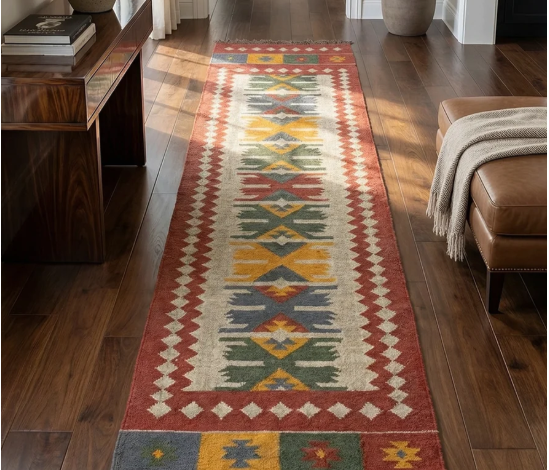
A hallway carpet is rarely chosen with the same attention as a living-room rug. The sofa gets measured, upholstery colours are compared, and the main seating arrangement is considered in detail. The passage connecting those rooms often receives whatever is left over.
That is a design oversight. A hallway is not an isolated strip of flooring. It connects the entrance to the living room, leads towards private bedrooms or links different parts of a house. Its carpet is therefore seen in relation to several interiors, sometimes from more than one doorway.
The better question is not simply which hallway carpet looks attractive. It is whether that carpet belongs to the visual arrangement of the home.
First, Is It a Hallway, an Entrance or a Passage?
These spaces are often grouped together in online rug shopping, but they have different architectural roles. An entrance foyer is the transition immediately inside the main door. A hallway is a passage connecting rooms, while a corridor may run through a larger floor plan and serve several doorways.
This distinction matters in Indian apartments. In many 2BHK layouts, the main door opens towards the living room rather than into a separate foyer. A small floor covering near the entrance may be an entry rug, not a hallway carpet.
An independent home may have a longer internal passage connecting the drawing room, bedrooms, and other spaces. Here, the carpet has a much longer visual relationship with the interiors around it.
Choosing the right category before choosing the design prevents a common mistake: buying a long runner for a space that is actually an entrance landing or part of the living room.
The Carpet Should Connect Rooms Without Making Them Look Identical
Consider a home where the living room has a large Persian-inspired rug, patterned cushions, and dark wooden furniture. Placing a second heavily patterned carpet immediately outside the room can create unnecessary competition.
A quieter hallway design may work better. It can borrow a shade from the living-room rug while using a smaller or more restrained motif. This creates continuity without making the two floor coverings look like a matching set.
The opposite approach can also work. A restrained living room with plain upholstery and neutral flooring may benefit from a more defined hallway pattern.
The useful principle is to coordinate through one or two visual elements rather than repeat everything.
| Living-room character | Hallway carpet direction |
| Strong floral or traditional pattern | Restrained border or simpler motif |
| Neutral upholstery and plain flooring | More defined geometric or ornamental pattern |
| Contemporary furniture and clean lines | Linear, abstract or low-contrast design |
| Several colours already competing | A subtle design that picks up one existing shade |
The objective is visual continuity, not uniformity.
In a Compact Apartment, the Hallway May Not Deserve a Full Runner
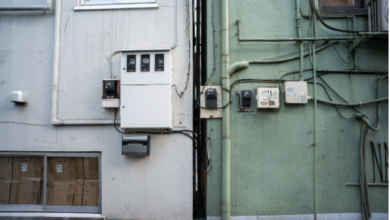
In a Mumbai apartment, for example, the entrance may open almost directly into the living room. A shoe cabinet, electrical panel, bedroom doors, and the edge of the sofa can occupy much of the available floor.
Treating this as a conventional long hallway can produce an awkward arrangement. A runner may extend into the living area, interrupt the flooring visually, or sit too close to furniture.
A smaller, clearly defined entrance rug may be the better choice. If there is a genuine passage leading towards bedrooms, a separate runner can be considered there.
The distinction is particularly useful in apartments where the entrance and living room share one continuous floor surface. The carpet should acknowledge the actual boundary between activities, even when there is no wall marking it.
A Long Villa Passage Needs a Different Kind of Visual Continuity
In a single-floor villa, a passage may connect the drawing room with bedrooms, a family lounge or a courtyard. The carpet is seen repeatedly while moving between these spaces.
Here, its relationship with doorways and the rooms at either end becomes important. A strong central motif may look impressive from one viewpoint but feel repetitive along a long passage. A bordered pattern or a design with a more measured repeat can provide visual rhythm.
The surrounding architecture matters too. A passage with wooden doors, artwork, and wall lights already contains several visual details. A quieter traditional carpet may hold the floor together. In a minimally furnished corridor, a more expressive design can provide the missing visual interest.
The carpet should support the architecture rather than compete with every element along the way.
Should a Hallway Carpet Match the Living-Room Rug?
Not necessarily. Matching is one way to establish continuity, but it is not the only way.
A more considered combination can use:
- Shared colour: The hallway carpet picks up one colour from the adjoining room.
- Different pattern scales: A detailed living room rug is paired with a simpler hallway design.
- Related design language: A geometric runner sits alongside a contemporary rug without repeating its exact motif.
- Controlled contrast: A darker hallway carpet creates a transition between lighter adjoining rooms.
One practical test is to view both carpets from the entrance or the main doorway. If their patterns compete at that distance, the combination may need reconsideration.
What Should You Examine Before Buying?
A hallway carpet is part of a working circulation space, so appearance cannot be the only consideration.
Check these four things before ordering:
- The adjoining floor: A handmade carpet against marble, vitrified tile or wooden flooring will produce different visual contrasts. Consider the undertone of the existing surface.
- The doorways: Bedroom and bathroom doors must open without catching the carpet.
- The visual weight: A dense, dark pattern can dominate a narrow passage, especially when the walls already carry artwork or decorative finishes.
- The transition: Look at the carpet from the entrance and from the adjoining living room. It should relate to both views.
For example, a muted geometric runner can sit comfortably between a neutral living room and a bedroom passage. A richly detailed Persian carpet may be more appropriate where the adjoining interiors already have traditional furniture and stronger decorative elements.
A Hallway Carpet Is Part of the Home’s Overall Composition
The passage between rooms may receive less attention during furnishing, but it is repeatedly visible from the spaces around it. That makes its relationship with the living room, entrance and private areas more important than an isolated styling decision.
The right hallway carpets do not have to match the adjoining rugs or introduce another statement pattern. They need to make the transition between rooms feel considered.
Before choosing one, look beyond the passage itself. Study the floor, the doorways, the adjoining furniture and the view from each end. A carpet that works with those elements will feel far more deliberate than one selected simply because its dimensions fit the corridor.